Shopify's UCP cart migration and the hidden risk of agentic checkout errors
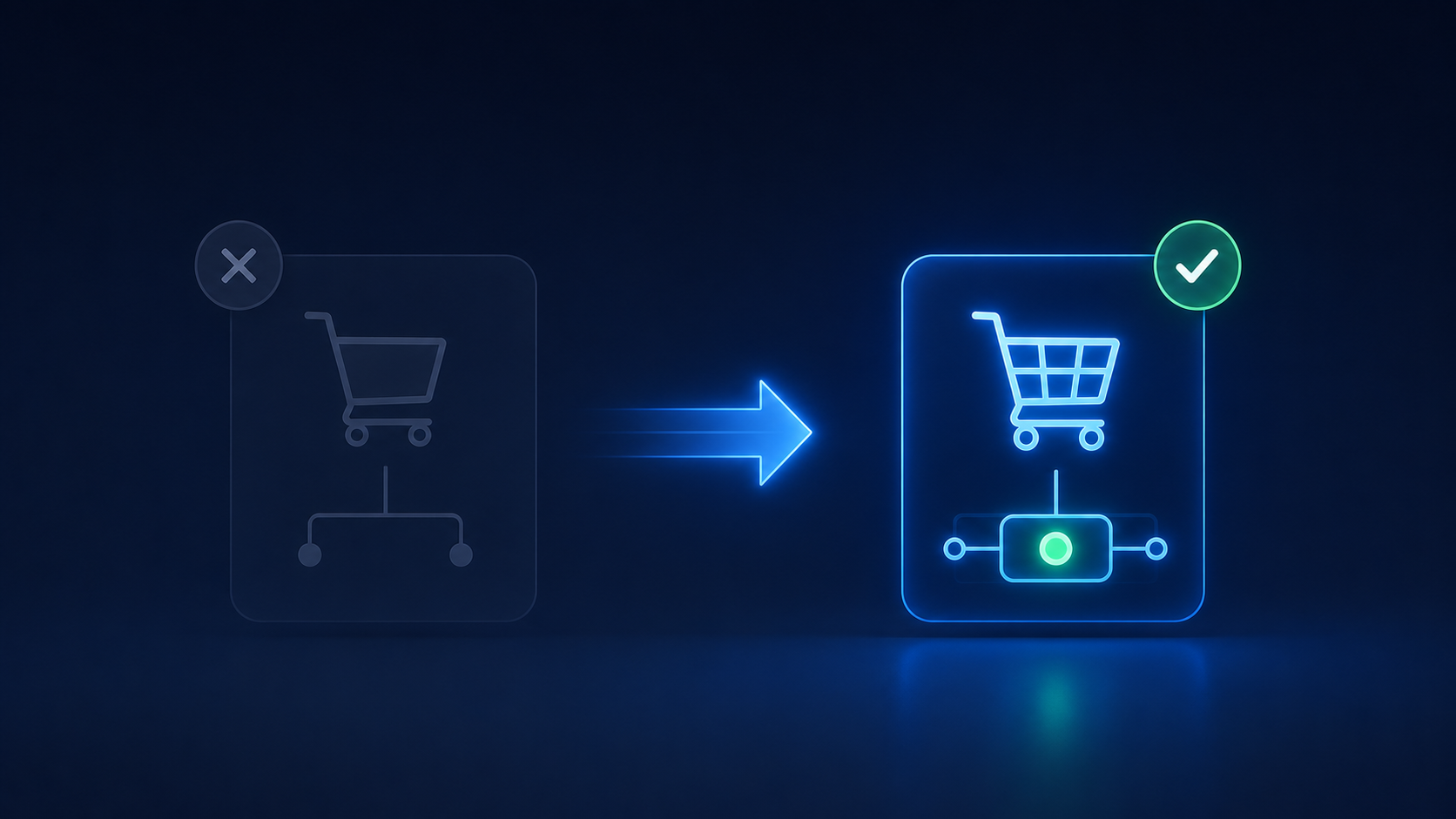
Yesterday, Shopify announced the deprecation of its Storefront MCP cart tools in favour of the new Universal Commerce Protocol (UCP) Cart MCP. The deprecated get_cart and update_cart tools on the Storefront MCP endpoint will be maintained until August 31, 2026, but Shopify is directing all developers to migrate to the new UCP-conforming Cart MCP tools at https://{shop-domain}/api/ucp/mcp.
This goes beyond a routine API version bump. It signals that agentic commerce, where AI agents browse, build carts, and complete purchases on behalf of shoppers, is becoming the operational reality for Shopify merchants. And with that reality comes an entirely new category of checkout risk that most eCommerce teams aren’t monitoring for.
What's actually changing
1. The update
The new Cart MCP implements the UCP cart capability (version 2026-04-08) and introduces four tools: create_cart, get_cart, update_cart, and cancel_cart.
There's a critical architectural difference: update_cart now uses PUT semantics, meaning each request replaces the cart's full state rather than patching individual fields. Developers must send the complete line_items array on every update.
Every request must also include a meta object carrying ucp-agent.profile, and cancel_cart requires an idempotency key (UUID). These are meaningful changes to request structure, and any implementation error, a missing meta field, an incomplete line_items array, a malformed idempotency key will silently break the checkout flow.
2. What does it mean
-
MCP stands for Model Context Protocol, the standard that lets an AI assistant talk directly to a store’s systems, the same systems that normally only respond to a person clicking through a website, using structured requests instead of rendered pages.
-
UCP, the Universal Commerce Protocol, is a broader standard that defines exactly how those structured requests should be formatted so that any AI agent, not just one built by Shopify, can reliably build a cart, check stock, and complete a purchase across different stores.
Shopify is aligning with an industry-wide language for how AI agents shop, which means the more agents adopt this language, the more cart and checkout traffic on your store will be agent-driven rather than human-driven.
The shift from PATCH-style updates to PUT semantics also matters in practice. Previously, updating a cart worked more like sending a note saying “add one more of this item.” Now, every update must resend the entire cart contents from scratch, every line item, every quantity, every time. If a developer’s integration accidentally leaves something out of that full list, the cart silently shrinks to whatever was actually sent, with no warning that anything went missing.
The idempotency key requirement adds another layer worth understanding. An idempotency key is simply a unique ID attached to a request so that if it gets sent twice, by accident, by a retry, or by an AI agent that isn’t sure if its first attempt worked, the system knows it’s the same request and doesn’t process it twice. A malformed or missing key can cause a cancel request to either fail silently or be processed incorrectly.
The monitoring blind spot
Here's what makes this transition particularly risky: these errors often don't trigger traditional error monitoring. A PUT request that inadvertently drops line items from a cart won't throw a 500 error. The API responds with a 200 status code. The cart looks valid. But the customer's carefully curated selection has been silently truncated.
Multiply this across the growing ecosystem of AI shopping agents, and the problem becomes systemic. According to Baymard Institute's 2026 data, the average cart abandonment rate already sits at approximately 70%. Technical causes, unexpected behaviour during checkout, slow load times, crashes, account for a significant slice of that number. When AI agents compound these issues by interacting with misconfigured cart APIs, merchants lose revenue without any visible alert in their dashboards.
As the HTTP Archive's 2025 Web Almanac (covered extensively by CSS-Tricks) highlights, the median mobile page now weighs 2,362 KB, a 202.8% increase over the past decade. JavaScript remains the heaviest contributor. In this context, adding new protocol layers and agent-driven API interactions on top of already heavy frontends creates fertile ground for performance degradation and silent failures.
Why traditional monitoring falls short
Conventional application performance monitoring tools are built to catch server errors, track response times, and alert on downtime. They're excellent at what they do. But they weren't designed for the nuances of eCommerce checkout flows, especially flows driven by third-party AI agents interacting through new protocols.
Consider what happens when a Shopify merchant migrates to UCP Cart MCP:
- Silent data loss: A update_cart call with PUT semantics that omits one product doesn't generate an error. It generates a smaller order.
- Agent-specific failures: Different AI agents may interpret the UCP schema differently, causing inconsistent cart behaviour that's invisible unless you're monitoring at the session level.
- Cascading performance issues: The additional meta objects and idempotency requirements add request overhead. On pages already struggling with Core Web Vitals (only 39% of eCommerce sites pass all three metrics, according to HTTPArchive data), this overhead can push Interaction to Next Paint (INP) past acceptable thresholds.
Continuous monitoring must go beyond surface-level metrics. You need to track whether real changes, like an API migration, actually improve or degrade the user experience.
Where AuditIQ fits
This is precisely the kind of problem AuditIQ was built to solve. Rather than waiting for customers to complain or for revenue dips to surface in weekly reports, AuditIQ continuously monitors your live eCommerce site from the perspective of real users.
When a UCP migration introduces a subtle cart calculation error, AuditIQ detects the anomaly, not because the server reported a failure, but because the user's experience deviated from the expected flow. When an AI agent's request triggers a layout shift or delays the checkout rendering, AuditIQ captures it in the context of actual Core Web Vitals performance, correlated with conversion data.
For Shopify merchants navigating this UCP transition, AuditIQ provides:
- Real-time checkout flow monitoring that catches silent failures traditional tools miss
- Core Web Vitals tracking is tied directly to conversion impact, so you can see when API changes degrade the metrics that matter
- Session-level visibility into how different agents and browsers interact with your checkout, helping you spot agent-specific issues before they become revenue problems
The window is now
Shopify has given merchants until August 31, 2026, to complete this migration. That's just over two months. If you're running a Shopify store with any meaningful volume, you need monitoring in place before you flip the switch, not after you've already lost a month of agentic cart revenue to silent failures.
The shift to agentic commerce is real and accelerating. The merchants who thrive won't just be the ones who adopt the new protocols fastest. They'll be the ones who can see, in real time, whether those protocols are actually working for every customer and every agent.
Get in touch with AuditIQ and learn how it can protect your checkout during the UCP migration and beyond.
About the author
Dan Garner writes from AuditIQ's experience monitoring eCommerce performance, SEO, security, and reliability issues across Magento, Shopify, WooCommerce, and Adobe Commerce stores.