Shopify and Vercel are rebuilding Hydrogen together: What it means for merchants and their monitoring stack

On June 30, 2026, Shopify and Vercel announced a significant deepening of their partnership: Hydrogen, Shopify’s official React-based framework for headless storefronts, is being rebuilt in close collaboration with Vercel. The result is tighter native integration between the two platforms and a new Deploy button that lets developers launch a Hydrogen storefront to Vercel in a few clicks, no local setup required.
For merchants and developers who have been watching headless commerce from a distance, this is a meaningful shift. For those already running headless storefronts, it’s a signal that the ecosystem is maturing fast, and the expectations around performance, reliability, and monitoring are rising with it.
What Shopify and Vercel actually announced
The headline feature is a new Deploy button: a single click creates a GitHub repository from the Next.js-based Hydrogen starter template, sets up a Vercel project, and builds and deploys it automatically. The template ships ready-to-use, with the typed Storefront API client wired up, cart functionality in place, and product and collection pages already configured.
In plain terms: Hydrogen is Shopify’s framework for building a custom storefront using React and Next.js, rather than Shopify’s default Liquid theme engine. Vercel is the hosting platform most commonly used with Next.js, running storefronts on a global edge network for faster page loads. Previously, connecting the two required local development setup and manual configuration. The new integration removes those steps entirely.
Beyond the Deploy button, the partnership signals something broader: Shopify and Vercel are actively co-developing Hydrogen going forward. This means merchants and developers who build on this stack can expect tighter performance optimisations, better tooling, and a more supported path to headless commerce than was previously available.
What this means for Shopify merchants
Headless commerce has always promised better performance and full creative control, but the barrier to entry has been high. Spinning up a custom frontend, configuring deployments, managing infrastructure, and maintaining the integration with Shopify’s APIs required significant development resources. The result was that headless commerce remained largely the domain of enterprise retailers with dedicated engineering teams.
The Shopify-Vercel integration changes that calculation. A mid-market merchant with a competent development team can now go from zero to a live Hydrogen storefront significantly faster. The starter template handles the foundational plumbing.
- Vercel handles the infrastructure.
- Shopify handles the commerce layer.
- What’s left is building the customer experience.
The performance implications are also real. Vercel’s edge network delivers pages from locations close to the shopper, reducing latency. Research consistently shows that every 100ms improvement in page load time can boost conversion rates by up to 7%. A headless storefront on Vercel, optimised correctly, can deliver meaningfully faster experiences than a traditional Liquid theme, particularly for international shoppers.
For brands with strong creative vision or complex product experiences, this is a genuine unlock. The full flexibility of React means no compromises on design, interaction, or personalisation. And with Shopify’s Storefront API handling commerce, the reliability of the checkout layer stays intact.
The monitoring gap nobody’s talking about
Here’s what the announcement doesn’t address: once these storefronts are live, who’s watching them?
With traditional Liquid themes, merchants benefit from Shopify’s own infrastructure monitoring. The platform catches server-side errors, handles scaling, and provides basic analytics. It’s not comprehensive, but there’s a safety net.
Headless storefronts are different. The frontend runs independently on Vercel’s edge network. The Storefront API handles data, but the rendering, routing, cart interactions, and checkout redirects all happen in custom code. When something breaks, a failed API call, a JavaScript error in the cart component, a slow product page that causes users to bounce, Shopify doesn’t see it. Vercel’s logs only tell part of the story.
This gap is especially dangerous because headless stores tend to have more complex client-side logic. Every API call is an opportunity for failure. Every custom component is a potential source of errors that silently erode conversion rates.
The stakes are high. Global cart abandonment reached 70.22% in 2026. Baymard Institute’s research shows that 18% of US online shoppers abandon orders due to a “too long or complicated checkout process”, but technical failures compound this by a further 15%. Site errors, failed API calls, and broken cart states push abandonment higher in ways that analytics platforms struggle to quantify.
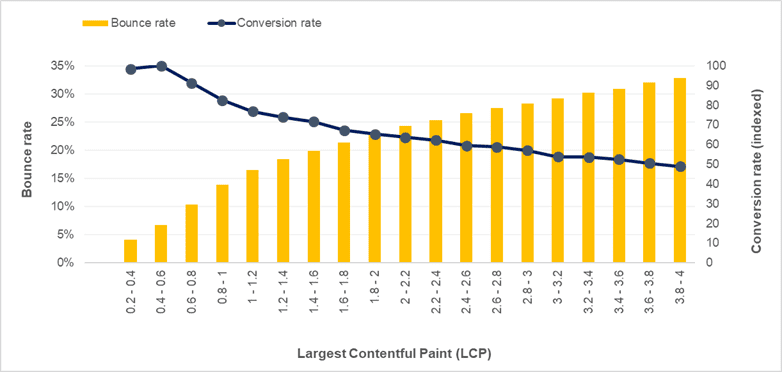 Google’s real-user data
According to Google’s analysis of over 10 million visits, improving Largest Contentful Paint (LCP) by just 1 second can increase conversion rates by 13% and reduce bounce rate by 14 percentage points. For a headless storefront making dozens of API calls per page load, LCP is directly tied to API response times, rendering performance, and error-free execution.
Headless freedom demands headless responsibility
Shopify’s Hydrogen-on-Vercel deployment is genuinely exciting for the ecosystem. It lowers the barrier to headless commerce, brings Shopify’s commerce capabilities to the modern frontend stack, and gives developers more flexibility than ever.
But flexibility without visibility is a liability. Every custom component, every API integration, every edge-rendered page is a surface area that needs monitoring, not just for uptime, but for the quality of the experience your customers actually receive.
This is the gap AuditIQ was built to close. For merchants deploying Hydrogen storefronts to Vercel, AuditIQ provides:
- Visibility into API failures that occur between the frontend and Shopify's Storefront API, including cart mutations, product queries, and collection fetches.
- Core Web Vitals tracking should be tied to real user sessions, so you can see how LCP, CLS, and INP behave for actual shoppers, not just synthetic tests.
- Error-to-revenue correlation that helps you understand whether a spike in JavaScript errors is an annoyance or a conversion emergency.
- Checkout flow monitoring that catches broken states before they accumulate thousands of abandoned carts.
The merchants who will thrive with headless aren't just those who build the fastest storefronts. They're the ones who know, in real time, when something isn't working, and can quantify exactly what it's costing them.
If you’re building or running a headless storefront and want to close the gap, AuditIQ eCommerce monitoring gives you the real-user visibility most infrastructure tools miss.
About the author
Dan Garner writes from AuditIQ's experience monitoring eCommerce performance, SEO, security, and reliability issues across Magento, Shopify, WooCommerce, and Adobe Commerce stores.