Shopify CLI 4.0 removes the safety net: Is your deployment pipeline ready?
Shopify CLI 4.0 removes the safety net: Is your deployment pipeline ready?
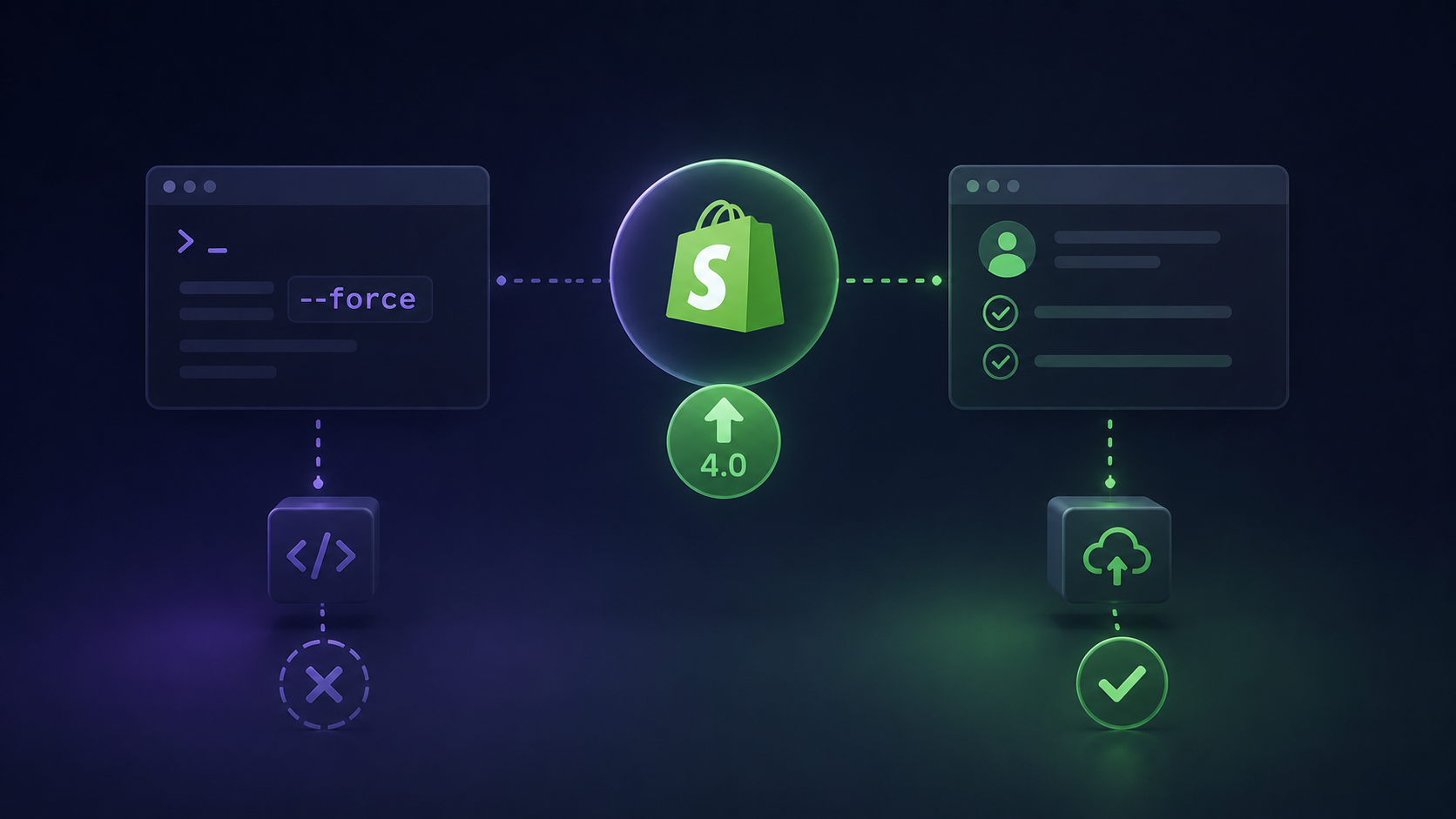
Yesterday, Shopify released CLI 4.0, and buried inside the headline features, semantic versioning, automatic updates, is a change that should make every eCommerce team pause: the --force flag on app deploy and app release is gone.
That single flag was the blunt instrument many CI/CD pipelines relied on to push changes unattended. It didn't distinguish between adding a new extension and deleting one permanently. Shopify's own changelog puts it plainly: the flag couldn't separate "low-risk operations (adding or updating extensions)" from "high-risk ones (deleting them)."
The replacement, --allow-updates and --allow-deletes, is more granular, and that's a good thing. But the migration demands attention. Any pipeline still referencing --force will break the moment it touches CLI 4.0. And with automatic upgrades now enabled by default, that moment could arrive sooner than you think.
Why this matters beyond Shopify
This is part of a broader pattern across eCommerce platforms: the infrastructure is getting smarter, but the blast radius of a misconfiguration is growing.
Consider what's happening across the ecosystem right now:
- Adobe Commerce released critical security patch APSB26-49 on May 12, addressing stored cross-site scripting vulnerabilities across every supported version from 2.4.4 through 2.4.9. If you're running Magento, the window between "patch available" and "exploited in the wild" continues to shrink.
- WooCommerce is reimagining its entire catalogue management interface with a proof-of-concept built on WordPress DataViews, inline variations, bulk edit, and quick edit in a single screen. More power for merchants, but also more surface area for things to go wrong during the transition.
Each of these developments shares a common thread: they increase velocity while raising the stakes of failure. Faster deploys. Broader APIs. More powerful admin interfaces. All excellent for productivity, all potentially catastrophic when something breaks on your live storefront.
The silent cost of deployment errors
The industry data tells a stark story. According to Baymard Institute's 2026 cart abandonment research, 15% of shoppers abandon their carts specifically because the website experienced errors or crashes.
At scale, these aren't rounding errors; they're revenue leaks. A site doing $10 million in annual revenue that experiences a checkout-breaking deployment bug for even a few hours can lose tens of thousands of dollars before anyone notices.
And "before anyone notices" is the critical phrase. In most eCommerce operations, the feedback loop between a deployment, a bug surfacing on the live site, a customer encountering it, and the team being alerted is measured in hours or days, not minutes.
The monitoring gap in eCommerce deployments
Traditional application performance monitoring (APM) tools are built for infrastructure teams. They'll tell you if a server is running hot or if an API endpoint is timing out. But they often miss the eCommerce-specific failures that actually cost revenue:
- A payment gateway integration that silently fails for customers using a specific browser on mobile
- A product page that renders correctly but has a broken "Add to Cart" button after a theme update
- A checkout flow that works perfectly in staging but throws JavaScript errors in production because of a third-party script conflict
These are the errors that live in the gap between "the site is up" and "the site is actually working for customers." They don't trigger server alerts. They don't show up in synthetic monitoring. They only become visible when you're watching what real users actually experience.
How AuditIQ closes the loop
This is exactly the problem AuditIQ was built to solve. Rather than waiting for customer complaints or staring at aggregate analytics days later, AuditIQ monitors your live eCommerce site from the perspective of real users, capturing the errors, performance degradations, and broken flows that traditional monitoring misses.
When Shopify CLI 4.0 deploys a change to your storefront, AuditIQ is watching what happens next. When an Adobe Commerce security patch introduces an unexpected interaction with your custom extensions, AuditIQ surfaces it before your customers surface it for you, by leaving.
The shift to granular deployment controls in Shopify CLI 4.0 is welcome. But controls only prevent the errors you anticipate. For everything else, the edge cases, the third-party conflicts, the mobile-specific rendering bugs, you need visibility into what's actually happening on your live site.
Deployments are getting faster. Make sure your monitoring keeps pace.
If your team is managing Shopify, Magento, WooCommerce, or any live eCommerce storefront, try AuditIQ for free. It gives you the real-time visibility to catch what your deployment pipeline can't.
About the author
Dan Garner writes from AuditIQ's experience monitoring eCommerce performance, SEO, security, and reliability issues across Magento, Shopify, WooCommerce, and Adobe Commerce stores.