Google Merchant Center goes down: Your revenue doesn't come back automatically
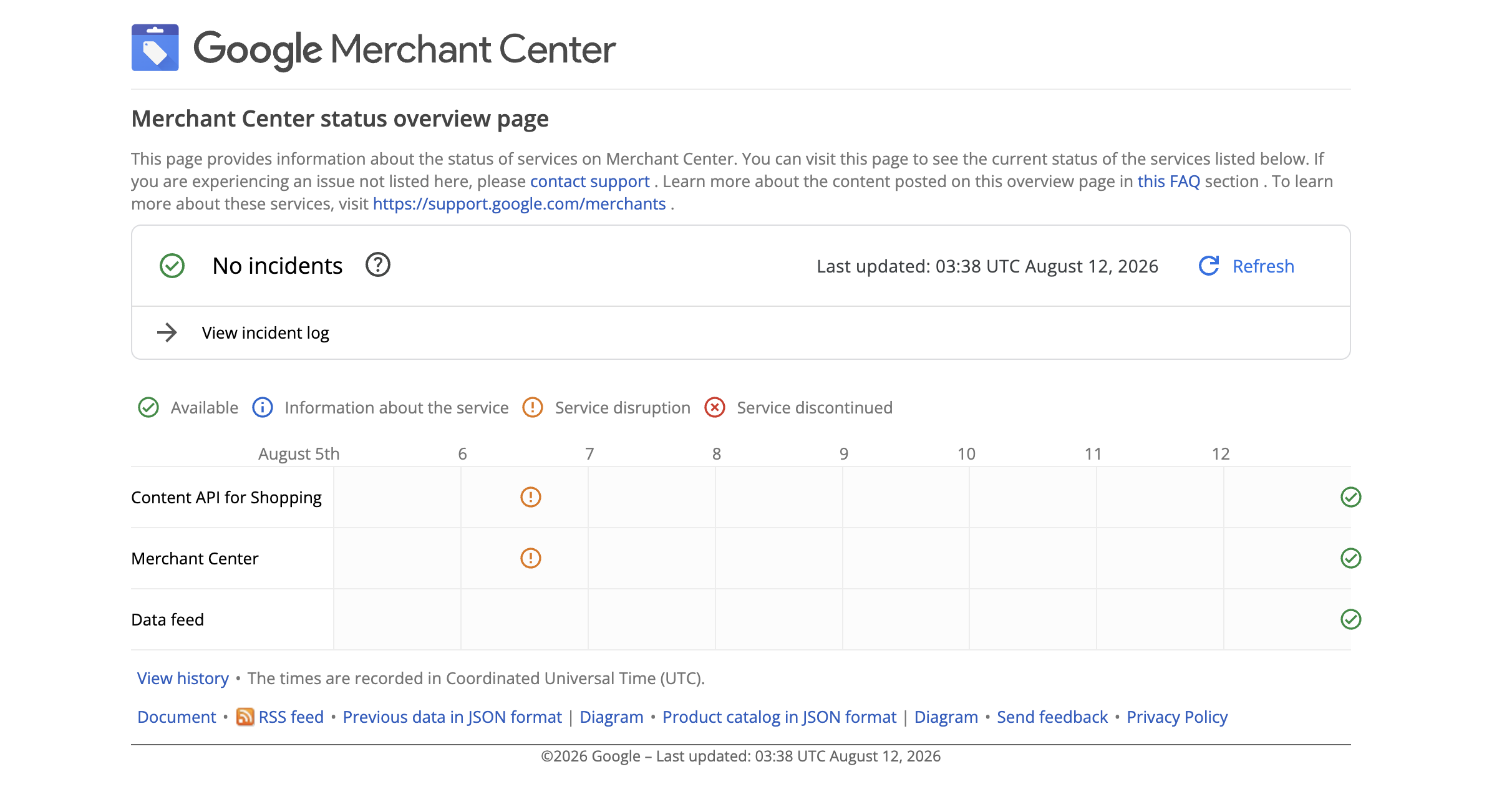
On August 6, 2026, Google Merchant Center experienced an outage that caused product listings to go inactive for merchants running Shopping campaigns and Performance Max, and many did not reactivate automatically when the platform recovered. If your store was affected, verify that every previously active product has returned to approved status in Merchant Center, and check that your feed data matches your current landing page prices and availability before Google's next crawl.
On August 6, 2026, Google confirmed it was investigating an incident affecting Google Merchant Center. The company disclosed neither the root cause nor the specific features impacted. For merchants running Shopping campaigns, Performance Max, and free product listings, the wait for clarity was anything but idle; it was expensive.
But here's what most merchants don't realise: the real cost of a Merchant Center outage isn't the downtime itself. It's what happens, or fails to happen, after the service is restored.
The status page turned green. The revenue didn't.
Within hours of the August 6 incident, Shopify merchants began reporting on Reddit that their product listings had gone inactive, with no automatic reactivation once Merchant Center's status page cleared. This is the pattern that repeats with every significant Merchant Center disruption: the platform recovers, but the merchant's product visibility does not recover with it.
The reasons are structural. When Merchant Center experiences an outage, several things can break silently:
-
Feed processing pauses. Products that should have been updated during the outage window retain stale data, old prices, outdated availability, and superseded descriptions. When the feed resumes, Google's crawlers may find mismatches between your feed and your landing pages, triggering disapprovals that didn't exist before the outage.
-
Crawl verification fails. Google periodically verifies that your product landing pages match your feed data. An outage can interrupt scheduled crawls, and when they resume, pages that loaded slowly or returned temporary errors during the recovery window get flagged. Price and availability mismatches between feed and landing page remain the top cause of preemptive item disapprovals, according to Productsup's 2026 analysis.
-
Campaign learning resets. Performance Max and Smart Shopping campaigns rely on continuous performance signals. An outage creates a gap in that signal, and when campaigns resume, the bidding algorithm may treat the post-outage period as a reset, spending aggressively to reacquire data or pulling back spend to protect targets.
-
Free listing eligibility lapses. Products that were eligible for free listings before the outage may not automatically regain that eligibility. Google's systems re-evaluate eligibility on resumption, and products with any data quality issue get quietly dropped.
The problem is assumption
The fundamental problem isn't that Merchant Center has outages; every platform does. The problem is that merchants assume recovery is automatic. They see the status dashboard turn green and return to other priorities, unaware that dozens or hundreds of their products are now invisible to shoppers.
This assumption is particularly dangerous for merchants with large catalogues. A store with 5,000 SKUs won't manually verify that every product reappeared in Shopping results. They might notice a revenue dip a few days later and attribute it to seasonal variation or competitive pressure, never connecting it to the outage that silently removed a portion of their catalogue from Google's shopping surfaces.
The Merchant Center outage is just the visible tip
What makes the August 6 incident instructive is how it mirrors a broader class of revenue reliability problems that eCommerce stores face daily, just without the status page notification.
Consider what happens routinely without any platform outage:
- A developer pushes a theme update that changes the price element's CSS class. Google's crawler visits the landing page, can't find the price, and disapproves the product.
- An inventory sync fails overnight. Your feed says "in stock" while your landing page says "sold out." Google flags the mismatch and suppresses the listing.
- A CDN cache serves a stale version of a product page. The crawler sees a different price than what's in the feed. Another disapproval, another invisible revenue leak.
These scenarios create the same outcome as a Merchant Center outage: products disappearing from Shopping results, but they happen without any status page notification at all. And they happen constantly.
What merchants actually need to monitor
The lesson from the August 6 outage isn't "be ready for Google to go down." It's that your product visibility on Google is a continuous operational concern that requires active monitoring, not periodic checking.
Here's what that monitoring needs to cover:
- Feed-to-landing-page consistency. Continuous verification that the prices, availability, images, and descriptions in your product feed match what's actually on your landing pages, not just at the moment of feed submission, but at the moment Google's crawler visits.
- Product disapproval detection. Real-time alerting when products move from approved to disapproved status, with enough diagnostic context to identify whether the cause is a feed issue, a landing page issue, or a Merchant Center processing error.
- Post-outage reactivation verification. After any Merchant Center disruption, systematic verification that every product that was active before the outage has returned to active status, not just spot-checking a handful of SKUs.
- Landing page health monitoring. Continuous checking that product pages load correctly, return appropriate HTTP status codes, and render their structured data (price, availability, product schema) consistently for both users and crawlers.
How AuditIQ closes the recovery gap
This is exactly the monitoring gap that AuditIQ eCommerce monitoring was built to fill. AuditIQ continuously monitors your live storefront, the same pages Google's crawlers visit, and detects the specific conditions that cause product disapprovals: price mismatches, availability discrepancies, broken structured data, slow-loading pages, and JavaScript errors that prevent product information from rendering.
When a Merchant Center outage ends, AuditIQ doesn't wait for you to notice the revenue gap. It verifies that your product pages are serving the correct data, flags any discrepancies before Google's next crawl, and gives your team the diagnostic detail to fix issues before they become disapprovals.
Because the most expensive moment in eCommerce isn't when the platform goes down. It's the hours and days after it comes back up, when you assume everything recovered, and it didn't.
Don't let a platform outage become a silent revenue leak. Start your free AuditIQ trial and monitor the storefront signals that determine whether your products stay visible on Google.
Others also read:
- Three changes of Google Merchant Center's September 2026 overhaul
- Google I/O 2026 merchant-free shopping vision
- Google's Demand Gen checkout links are expanding
FAQs
1. How do I check if my products were affected by the August 6 Merchant Center outage?
Go to Google Merchant Center and filter your product feed by "Disapproved" and "Pending" status. Compare the count to your pre-outage baseline. Pay particular attention to products that were previously approved but now show availability or price mismatch errors, these are the most common post-outage disapproval causes.
2. Will my Performance Max campaigns recover automatically after a Merchant Center outage?
Campaigns resume serving once products are reapproved, but the bidding algorithm treats the outage gap as missing data. Expect a period of performance volatility while Smart Bidding recalibrates. Monitor CPA and ROAS closely for 5-7 days post-outage and consider adjusting target bids temporarily if the algorithm behaves erratically.
3. What's the fastest way to reactivate products that went inactive during the outage?
Trigger a manual feed resubmission through Merchant Center or your feed management tool. For products with disapprovals, fix the flagged issues first; submitting a feed with known errors won't reactivate them. If the disapprovals are false positives caused by the outage itself rather than genuine data quality issues, use the "Request Review" function in Merchant Center for affected products.
About the author
Dan Garner writes from AuditIQ's experience monitoring eCommerce performance, SEO, security, and reliability issues across Magento, Shopify, WooCommerce, and Adobe Commerce stores.