eCommerce rankings dropped after Google's August 2026 spam update? Here's how to diagnose and recover
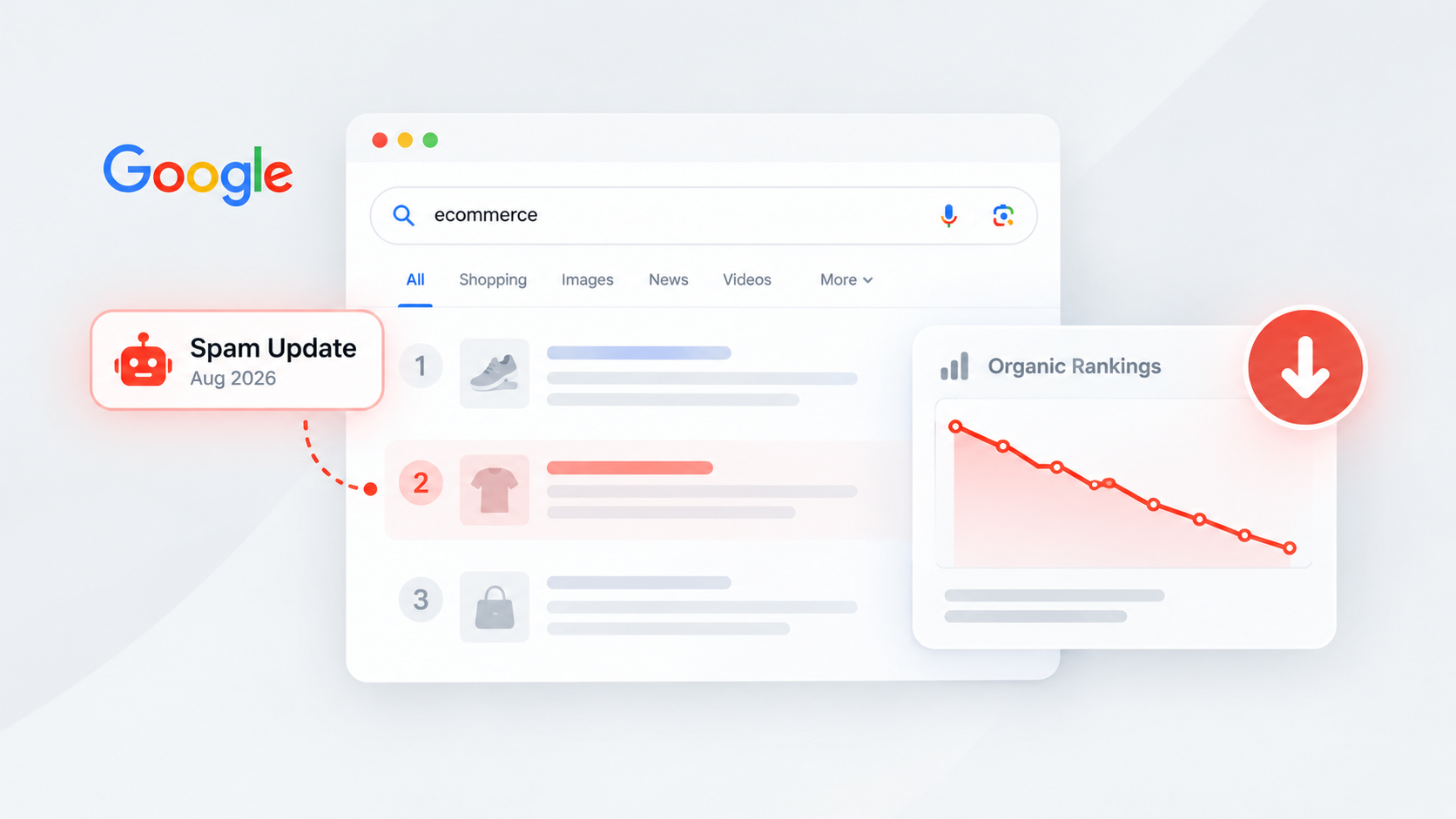
Google's August 2026 spam update rolled out from August 18 to 21 (2 days and 16 hours) and eCommerce sites with scaled product descriptions, thin category pages, or programmatic SEO content have reported ranking and traffic drops. Confirm the timeline in Search Console, identify the specific pages that lost visibility, remediate thin or templated content, then monitor for recovery. Google's systems can take months to reassess a site after you fix policy violations.
Google's August 2026 spam update rolled out from August 18 to 21, lasting 2 days and 16 hours. eCommerce sites with scaled product descriptions, thin category pages, or programmatic SEO content are reporting significant ranking and traffic drops. Recovery requires identifying the specific pages that triggered the spam classification, remediating those content patterns, and then monitoring for the ranking restoration that typically follows as Google's systems reassess the site.
How to tell if your eCommerce site was actually hit
Not every traffic drop during this window is a spam update casualty. Before you start making changes, confirm the update is actually responsible.
Step 1: Check the timeline.
In Google Search Console, navigate to Performance → Search Results. Set the date range to August 15–27. If your traffic dropped sharply between August 18 and 21, the spam update is a likely factor. If the drop started earlier or later, look at other causes: server issues, crawl errors, or the May 2026 core update's lingering effects.
Step 2: Check for manual actions.
Go to Search Console → Security & Manual Actions → Manual Actions. If you see a notification, that is a separate (and more urgent) issue. Spam updates are algorithmic; they produce no manual action notification, which makes them harder to diagnose.
Step 3: Identify which pages lost.
In Search Console Performance, filter by page and compare the two weeks before the update to the week after. Sort by largest click and impression losses. The pages with the steepest declines reveal the content patterns Google flagged.
Step 4: Cross-reference with revenue data.
In GA4, check Acquisition → Traffic Acquisition → Organic Search. Revenue attributed to organic search landing pages tells you the financial impact more accurately than raw traffic numbers. Even modest ranking drops can translate to meaningful revenue loss for stores that rely on organic search.
Content patterns that trigger spam classification on eCommerce sites
Google's spam update does not target "eCommerce" as a category. It targets content practices that happen to be common on eCommerce sites. Review Google's spam policies and focus on these patterns most likely to cause ranking drops:
Scaled or templated product descriptions
If your product pages share near-identical descriptions with only a few attributes swapped (size, colour, material), Google may classify them as thin or auto-generated content. This is especially common for stores with hundreds or thousands of variants where descriptions were generated programmatically.
What to check: Sample 10 product pages that lost rankings. Read the descriptions. If you can swap the product name and the description would still work for a different product, that is the pattern Google is targeting.
Thin category and collection pages
Category pages that consist primarily of a product grid with no substantive content, no buyer guidance, no filtering context, no unique descriptive text, are vulnerable to being classified as doorway pages or thin content, especially if they target commercial keywords.
Programmatic SEO landing pages
Pages generated at scale to target long-tail queries (for example, "best [product type] for [use case] in [location]") with templated content are a primary target of spam updates. If these pages add no unique value beyond combining variables, Google treats them as scaled content abuse.
Scraped or syndicated manufacturer content
Using manufacturer-supplied product descriptions verbatim is technically duplicate content. While not always penalised, a spam update may reclassify these pages if the same descriptions appear across dozens of competing stores.
Step-by-step recovery framework
Recovery from an algorithmic spam update requires targeted remediation, not wholesale site changes. Follow this process:
1. Classify your affected pages
Group the pages that lost rankings into categories: product pages, category pages, programmatic SEO pages, blog content. Each category likely has a different content issue and needs a different fix.
2. Audit content quality page by page
For each group, evaluate a sample of 10–20 affected pages against Google's spam policies:
- Does the page have substantial unique content? Product pages need more than specifications and a price.
- Does the page serve the searcher's intent? A category page for "women's running shoes" should help someone choose, not just list products.
- Was the content generated at scale with minimal human oversight? This includes AI-generated descriptions that were not reviewed and edited.
- Is the content duplicated from another source? Check for manufacturer descriptions used verbatim.
3. Remediate the most impactful pages first
Prioritise by revenue impact, not by traffic volume. A product page that drives meaningful organic revenue matters more than a blog post that generates visits but no conversions.
- For product pages: Add unique, specific descriptions. Include genuine use-case information, sizing guidance, material details, or comparison context. Each description should be identifiably different from every other product on your site.
- For category pages: Add 150–300 words of genuinely useful category context above or below the product grid. Explain what distinguishes the category, who it is for, and what buyers should consider.
- For programmatic pages: Either add substantial unique content to each page or consolidate low-value pages and redirect them to the strongest remaining page in each topic cluster.
4. Request re-crawling
After remediation, submit the updated URLs through Search Console's URL Inspection tool. Google typically re-crawls changed pages within days to a couple of weeks depending on site authority and page importance.
5. Monitor for recovery
Spam update recoveries do not happen overnight. Google's documentation states that making changes may help a site improve if automated systems learn over a period of months that the site complies with spam policies. Expect to see ranking restoration over weeks to months as Google re-crawls and re-evaluates your pages. Some sites only fully recover when the next spam or core update rolls out. See Google's guidance on spam updates for the official recovery framing.
How to verify recovery
Recovery is confirmed when:
- Impressions and clicks return toward pre-update levels for the specific pages you remediated. Check Search Console Performance data weekly.
- Average position stabilises or improves for the keywords those pages were ranking for.
- Organic revenue recovers in GA4 for the affected landing pages.
Do not assume recovery is complete based on one week of data. The August 2026 spam update is Google's third spam update this year (following March and June), and ranking volatility between updates is normal.
Why this keeps happening to eCommerce sites
eCommerce sites are structurally vulnerable to spam updates because they naturally produce content at scale: hundreds or thousands of product pages, dozens of category pages, and increasingly, programmatic SEO content targeting long-tail queries. When these pages follow templates without sufficient unique value, they match the patterns spam updates are designed to catch.
Even a drop of a few positions can cut click-through rates sharply. For eCommerce, where organic search drives a substantial share of revenue, that translates directly to lost sales.
Prevention: Catching ranking regressions before they compound
The most dangerous aspect of algorithmic spam updates is the detection delay. Most merchants do not check Search Console daily. By the time they notice a traffic drop, they have already lost a week or more of organic revenue.
Continuous monitoring solves this. Rather than waiting for month-end reporting to reveal a traffic decline, storefront monitoring that tracks organic visibility, structured data integrity, and content rendering daily can alert you within 24 hours of a significant ranking change.
AuditIQ helps eCommerce teams correlate ranking drops with specific storefront changes: a deployment that altered product descriptions, a theme update that broke structured data, or a plugin that modified canonical tags, so you can fix the root cause before the traffic loss accumulates.
Beyond ranking visibility, AuditIQ is a comprehensive eCommerce monitoring platform purpose-built for Magento, Adobe Commerce, and Shopify stores. It also covers uptime, real-user performance, technical SEO, GEO readiness, analytics, and Google Ads performance from a single unified dashboard.
Monitor organic visibility and storefront integrity daily so the next spam update does not cost you a week of revenue before you notice.
FAQs
1. How long does recovery from a Google spam update take?
Google's documentation indicates that automated systems may need months to reassess a site after you fix policy violations. Expect ranking changes over weeks to months. Some recoveries happen gradually; others restore more noticeably when the next algorithm update rolls out. Monitor weekly rather than daily to avoid reacting to normal ranking fluctuation.
2. Will removing affected pages help my site recover faster?
Only if those pages genuinely violate spam policies and cannot be improved. Removing pages that rank for valuable keywords should be a last resort. Improve them first: add unique content, restructure thin sections, and consolidate duplicate pages.
3. My product pages use manufacturer descriptions. Is that why rankings dropped?
Possibly. Manufacturer descriptions used verbatim across many stores are duplicate content by definition. Adding unique buying guidance, customer context, and specific product details is the most effective fix.
4. Could the ranking drop be from the May 2026 core update instead?
Yes, core update effects can manifest weeks after rollout ends. Compare your traffic timeline carefully against both the May core update and the August spam update (August 18–21) to attribute the drop correctly.
5. Should I worry about AI-generated product descriptions being flagged as spam?
AI-generated content is not automatically spam, but AI content published at scale without meaningful human review or editing matches the patterns Google targets. If your AI descriptions are generic, repetitive, or interchangeable between products, they are at risk.
About the author
Dan Garner writes from AuditIQ's experience monitoring eCommerce performance, SEO, security, and reliability issues across Magento, Shopify, WooCommerce, and Adobe Commerce stores.