Your products exist but AI can't find them: How Generative Engine Optimisation is reshaping eCommerce discovery

Something fundamental has changed in how consumers discover products. It's not a gradual shift; it's a structural one. When a shopper asks ChatGPT "What's the best waterproof hiking boot for wide feet under $200?" or uses Google's AI Mode to compare skincare routines, the answer isn't a list of ten blue links. It's a curated, conversational response that cites specific products from specific pages.
If your products aren't being cited, they don't exist in this new discovery layer. And the data emerging in 2026 suggests that most eCommerce stores aren't ready.
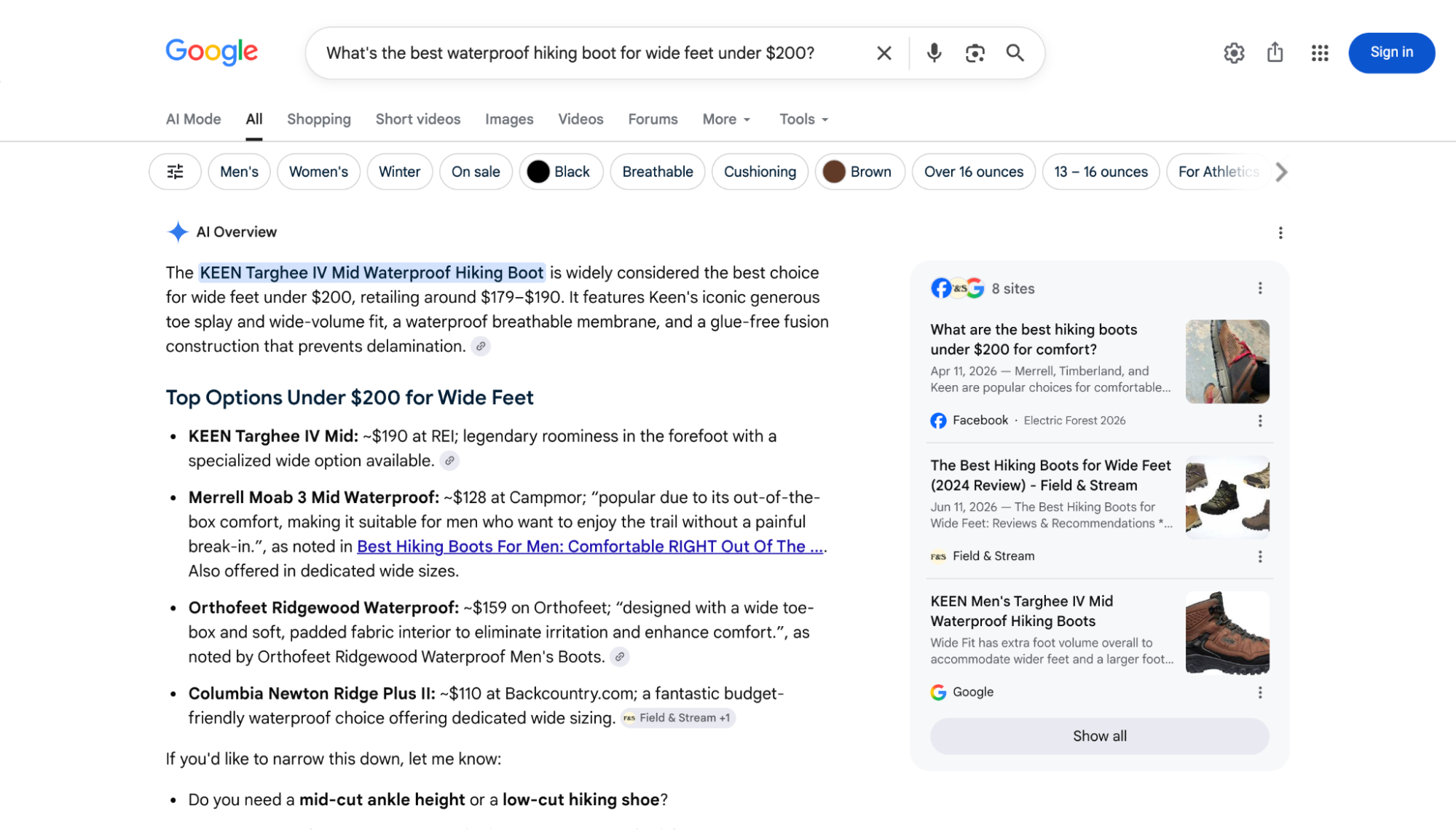 AI is changing how people search for desired products
The numbers that should worry every merchant
Research published this month offers some of the clearest evidence yet of what makes a product page citable by AI engines. According to analysis by SE Ranking and a 2026 SSRN study by Fischman, 65% of pages cited by Google AI Mode include structured data. A separate Growth Marshal study of 730 ChatGPT citations puts that figure even higher: 71% of cited pages use schema markup.
These aren't theoretical findings. They describe the mechanics of how AI search engines decide which products to recommend, and they reveal that structured data isn't optional; it's the table stakes for being included in AI-generated answers.
Meanwhile, new academic research is making this more measurable. The E-GEO dataset, published on arXiv on July 14, 2026, provides a testbed of 13,747 realistic, multi-sentence consumer product queries matched with Amazon listings. It's the first large-scale benchmark designed specifically to evaluate how product content performs in generative engines. The findings confirm what the citation statistics suggest: product pages optimised for human readers aren't necessarily optimised for AI readers.
What AI engines actually read
Traditional SEO taught merchants to think about keywords, meta descriptions, and backlinks. Generative Engine Optimisation (GEO) requires a different mental model.
AI engines don't scan for keywords in the traditional sense. They parse structured data, Product schema, Offer schema, Review schema, to extract machine-readable facts: price, availability, specifications, ratings, shipping information. They look for quantitative, sourced claims rather than marketing language. They favour content that answers specific, complex queries with direct, evidence-backed statements.
This means the eCommerce merchant's GEO challenge isn't primarily about writing better product descriptions (though that helps). It's about ensuring that the structured data on every product page is accurate, complete, and consistently maintained.
And that's where the problem gets operational.
The monitoring gap in GEO readiness
Here's what makes GEO different from traditional SEO in a way that matters for day-to-day eCommerce operations: structured data breaks silently.
When a product goes out of stock, and the Offer schema still shows "InStock," the page doesn't produce a visible error. When a price changes in the backend but the JSON-LD on the product page serves the old price for cached versions, no alarm rings. When a theme update accidentally strips the Review schema from product pages, no one notices until weeks later when search visibility drops, or when the AI engines simply stop citing those products.
These aren't edge cases. They're the everyday operational reality of running a store with hundreds or thousands of product pages, where content is managed by multiple teams, prices change daily, and platform updates can silently modify template output.
Traditional SEO auditing, a monthly crawl, a quarterly technical review, catches some of these issues, but not quickly enough. In a world where AI engines can re-evaluate your product pages daily, a schema markup error that persists for two weeks is two weeks of invisible lost discovery.
Beyond schema: The full stack of GEO signals
Structured data is the most measurable GEO signal, but it's not the only one. AI engines also evaluate:
1. Page quality and performance. A product page that takes four seconds to load on mobile may not be fully rendered when an AI engine crawls it. With only 55.9% of origins passing all three Core Web Vitals as of May 2026 CrUX data, and many eCommerce stores falling below that threshold, performance problems can directly reduce AI citability.
2. Content depth and specificity. Product pages that answer specific questions, "What is the weight of this boot?" "Is it waterproof in sustained rain or just splashes?", are more likely to be cited in conversational AI responses. Pages that rely on generic marketing copy provide nothing for the AI to cite.
3. Consistency across the storefront. AI engines can detect when your product feed says one thing, your landing page says another, and your structured data says a third. This kind of inconsistency, which is exactly the pattern that plagues Google Merchant Center compliance, will also hurt GEO visibility.
4. Content freshness. AI engines appear to prefer recently updated content. Product pages that haven't been touched in months, even if the product is still actively sold, may be deprioritised in generative results.
GEO is a monitoring problem, not just a marketing project
The traditional approach to GEO readiness involves a one-time audit: check your schema, improve your product descriptions, add FAQ content, and move on. But the evidence suggests this approach will fail for the same reason one-time SEO audits fail: eCommerce storefronts are dynamic environments where content changes constantly, often without the marketing team knowing.
The merchants who will maintain GEO visibility are the ones who monitor their structured data integrity continuously, detect schema breakage before AI engines encounter it, verify that product page content matches what's in their feeds and inventory systems, and catch template-level changes that strip or corrupt structured data across entire product categories.
This is where continuous storefront monitoring becomes the foundation of a GEO strategy rather than an afterthought. AuditIQ eCommerce monitoring tool monitors the customer-facing layer of your store, including the structured data, content, and performance signals that AI engines evaluate, and alerts you when something changes that could affect your discoverability.
The window is now
GEO is still early enough that the merchants who get it right in 2026 will have a significant advantage. AI search is growing rapidly, but most eCommerce stores haven't adapted their monitoring to match. The 65–71% structured data citation rate tells us exactly what AI engines are looking for. The question is whether your store is consistently delivering it, not just today, but every day, across every product page, through every platform update.
The merchants who treat GEO as a monitoring discipline rather than a one-time project will be the ones whose products appear in AI-generated recommendations. The rest will be invisible in the fastest-growing discovery channel in eCommerce.
Book a free AuditIQ demo to see how continuous storefront monitoring catches the compromise and breakage that patching alone can't tell you about.
About the author
Dan Garner writes from AuditIQ's experience monitoring eCommerce performance, SEO, security, and reliability issues across Magento, Shopify, WooCommerce, and Adobe Commerce stores.