Is your store agent-ready? What Cloudflare's new score means for eCommerce monitoring
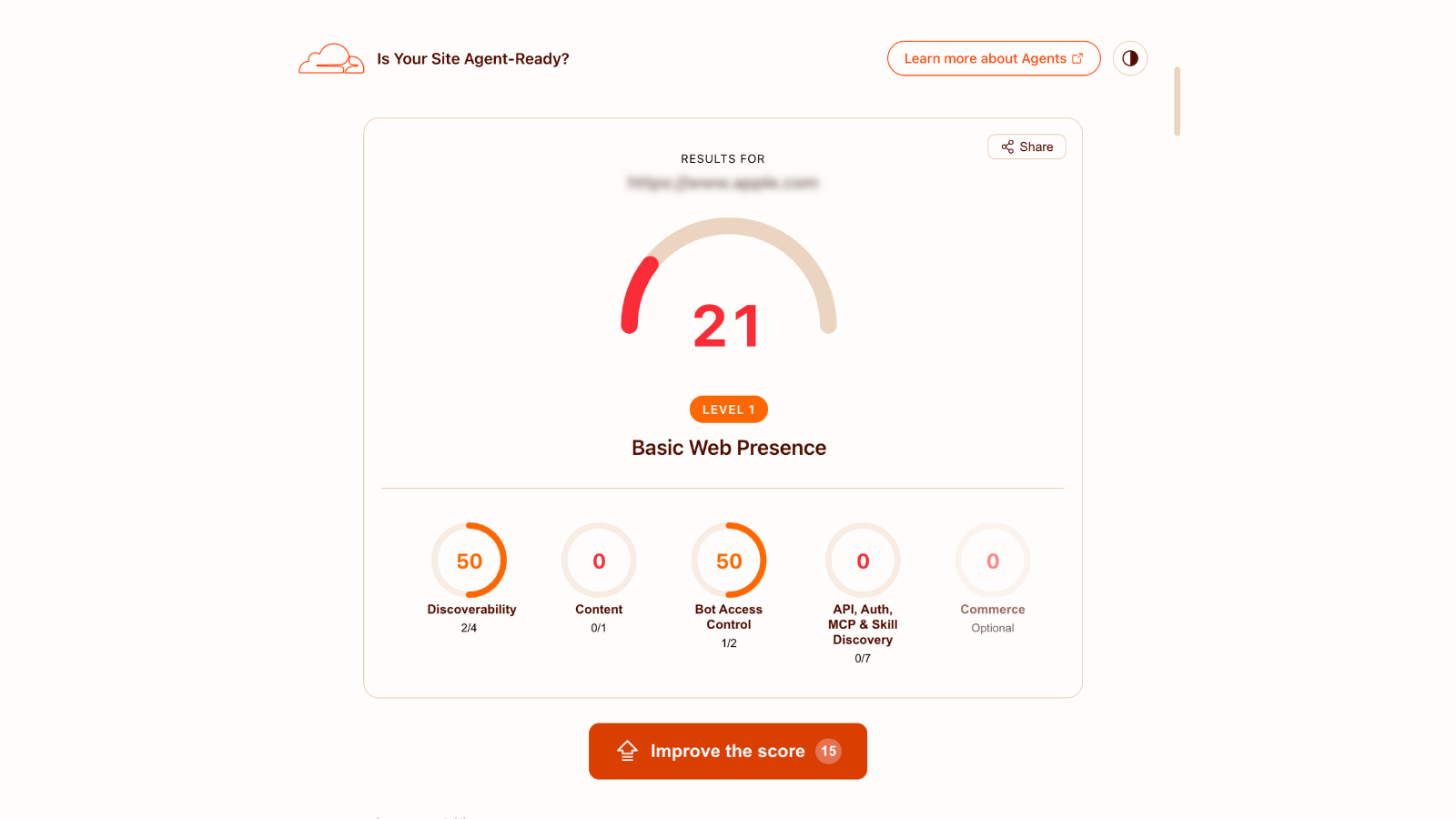
On April 17, 2026, Cloudflare introduced the Agent Readiness score, a new metric that evaluates how well websites support AI agents. Available via their isitagentready.com tool, it examines whether your site provides the structured data, API endpoints, and machine-readable content that AI agents need to interact with your business programmatically.
For eCommerce merchants, this isn't an abstract concept. It's a signal that the industry is formalising what many of us have been seeing for months: a growing percentage of your "customers" aren't humans in browsers. They're AI agents calling your APIs on behalf of real people.
The agent commerce shift is happening now
The timing of Cloudflare's announcement is telling. Within the same seven-day window:
- WooCommerce published the first part of a three-part series on their native Model Context Protocol (MCP) integration, showing how AI assistants like Claude and ChatGPT can browse products, manage carts, and access store policies directly.
- Shopify Hydrogen 2026.1.4 (shipped April 9th) added automatic MCP proxy support, meaning AI assistants can connect to Hydrogen storefronts with zero code changes.
- Cloudflare's Agents Week delivered a torrent of AI agent infrastructure: Agent Memory for persistent recall, Browser Run for giving agents browser access, Project Think for next-generation agent SDKs, Flagship for sub-millisecond feature flags, and a unified AI inference platform supporting 14+ model providers.
This isn't speculation about a future trend. It’s the infrastructure being deployed right now to support a commerce channel that already exists.
What agent readiness actually means for eCommerce
Cloudflare's Agent Readiness score evaluates factors like structured data availability, API discoverability, and content machine-readability. For eCommerce, translate this into concrete questions:
-
Can an AI agent find your products? Not through a search bar on a webpage, but through structured product data exposed via APIs or machine-readable formats. If your product catalogue lives behind JavaScript rendering and dynamic pagination, an agent can't browse it.
-
Can an AI agent add items to a cart? Both Shopify and WooCommerce now support this natively. But "support" and "works reliably in production" are very different things, as Shopify's VisitorConsent bug this week demonstrated.
-
Can an AI agent complete a purchase? This is where complexity explodes. Consent management, payment processing, address validation, inventory checks, discount application: all of these steps need to work programmatically, without visual UI cues that help human shoppers navigate errors.
-
Can an AI agent handle errors gracefully? When a Cart Transform Function fails and returns the new
MERCHANDISE_LINE_TRANSFORMERS_RUN_ERRORcode introduced in Shopify's 2026-04 API, does the agent know what to do? When a metafield write hits the new 128KB cap, does the agent receive a meaningful error response?
The monitoring gap nobody's talking about
Here's what makes this shift so challenging: almost all existing eCommerce monitoring tools were built for the browser experience. Heatmaps track mouse movements. Session replays record visual interactions. Google Analytics measures pageviews and clicks. Core Web Vitals evaluate loading performance, interactivity, and visual stability for humans.
None of this applies when an AI agent calls your Storefront API.
When a human encounters an error during checkout, they see a broken page, maybe try again, and, in about 15% of cases, according to Baymard Institute, abandon their cart citing a technical problem. That abandonment shows up in your analytics. You can measure it, investigate it, and fix it.
When an AI agent encounters an error, it fails silently. The consumer who asked their assistant to "find me a blue running jacket under $150" simply gets told that nothing matching was found, or that the purchase couldn't be completed. Your analytics show nothing: no session, no pageview, no cart abandonment. Just a sale that never existed.
Google's March 2026 core update increased the weight of Core Web Vitals in ranking algorithms, and research shows sites hitting "good" CWV thresholds see up to 25% conversion improvements. That matters enormously to the human visitors to your store. But CWV scores have zero relevance for the agent traffic channel. You need a parallel monitoring strategy.
Cloudflare’s other announcement this week, shared compression dictionaries, illustrates how new infrastructure can create additional silent failure modes alongside the agent channel. This technology shrinks asset transfers between servers and browsers, improving page load times for returning visitors and making API responses more efficient for agents.
But compression dictionaries need to be negotiated correctly between client and server. A misconfiguration won’t produce a visible error; it will serve slower or corrupted data to clients that expected compressed content. The same monitoring gap that makes agent errors invisible applies here: the failure is real, the revenue impact is real, but the signal never reaches your dashboard.
Building a dual monitoring strategy
The eCommerce merchants who will thrive in this new landscape are those who recognise that they're now operating two storefronts: the visual one that humans visit, and the API surface that agents query. Each needs its own monitoring approach.
For the human channel, Core Web Vitals remain critical. Google confirms that LCP under 2.5 seconds, INP below 200 milliseconds, and CLS under 0.1 are the thresholds that correlate with conversion improvements. Improving UX in legacy systems is a timely reminder that many eCommerce teams are working with monitoring infrastructure built for a simpler era.
For the agent channel, you need API-level observability: response time tracking, error rate monitoring, schema validation, and, critically, correlation between API failures and revenue impact. When a product query returns an error to an AI agent, what's the dollar value of that missed interaction?
Across both channels, you need real user monitoring that captures what's actually happening in production, not what your synthetic tests say should happen. This is where AuditIQ provides unique value. By monitoring real sessions and real API interactions, AuditIQ gives eCommerce teams visibility into both channels simultaneously, correlating errors with revenue impact regardless of whether the "user" is a human or an agent.
What to do this week
Closing the gap between your current monitoring setup and what agent commerce requires doesn’t need to happen all at once. Start here:
- Check your Agent Readiness score at isitagentready.com. Treat it as a baseline, not a final grade.
- Audit your API error handling. If you're on Shopify Hydrogen, ensure you've updated to 2026.4.1 and review your cart operation error handling for the new error codes. If you're on WooCommerce, explore the MCP integration documentation and test it against your production configuration.
- Review your monitoring coverage. Does your current setup capture API-level errors with the same fidelity as browser-level errors? Can you correlate either with revenue impact?
- Start tracking agent traffic separately. Even basic segmentation of API traffic by user-agent will reveal how much of your interaction surface is already agent-driven.
The eCommerce merchants who will thrive in this landscape are those who recognise they’re now operating two storefronts: the visual one that humans visit, and the API surface that agents query. Each needs its own monitoring approach.
Give AuditIQ eCommerce monitoring tool a try and see how it can help you monitor both your human and agent storefronts.
About the author
Dan Garner writes from AuditIQ's experience monitoring eCommerce performance, SEO, security, and reliability issues across Magento, Shopify, WooCommerce, and Adobe Commerce stores.