Being found by AI: why GEO is the new SEO for eCommerce
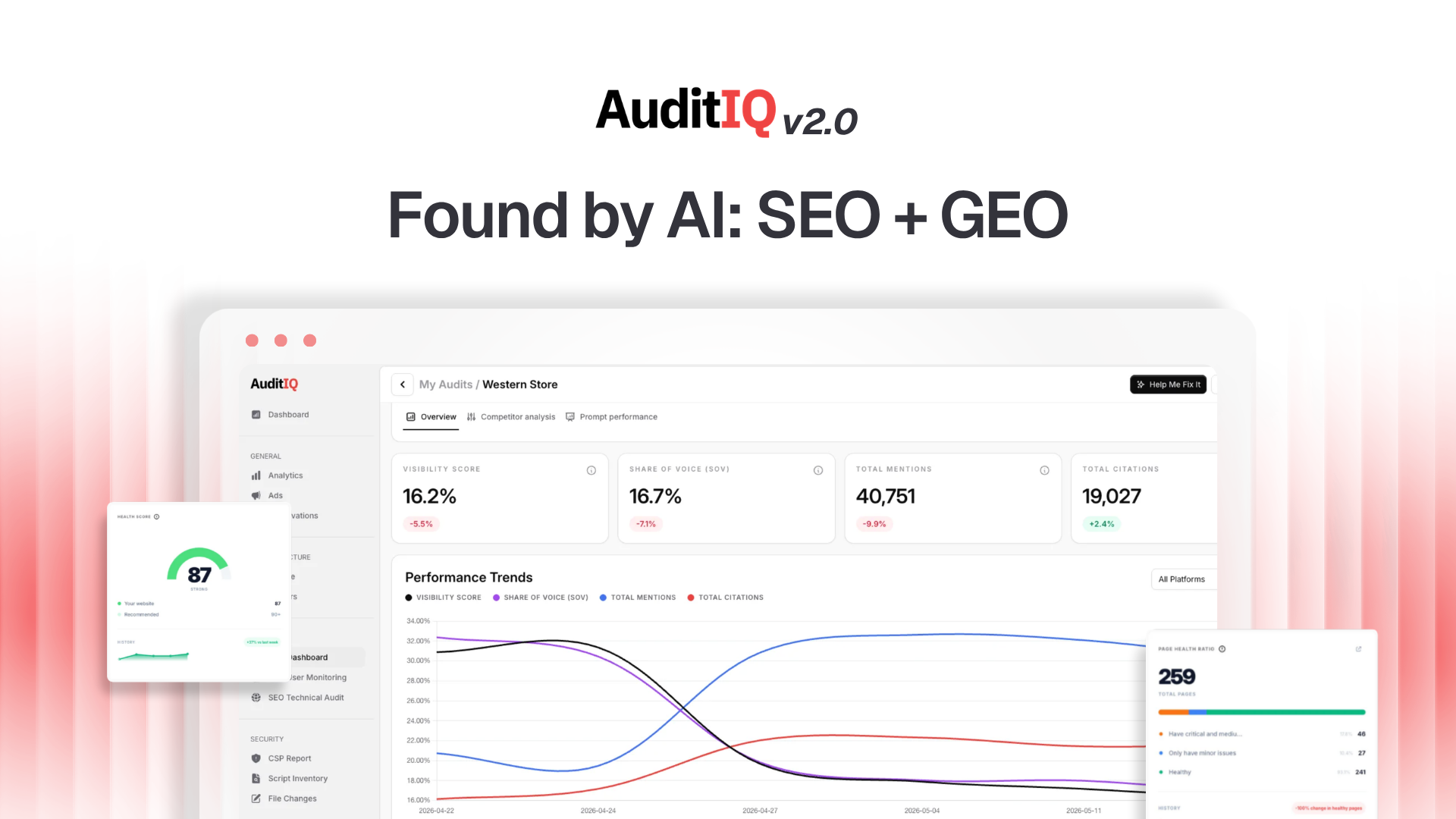
For two decades, ranking on Google meant being found. That logic still holds, but the landscape underneath it is shifting faster than most eCommerce teams have caught up with.
AI is changing how customers discover products. Ahrefs research found that when Google's AI Overview appears, the click-through rate for the organic position ranked first drops by up to 58%. A growing share of product discovery now happens through AI assistants that summarise options and recommend products without the customer ever seeing a traditional results page. SEO gets you ranked. Generative Engine Optimisation (GEO) gets you recommended.
Both matter now, and both require continuous monitoring. In this article, we look at why the shift is happening, what it means for your store, and how AuditIQ v2 audits for both SEO and GEO in one platform.
What changes when AI is the front door
When a customer asks an AI assistant "what is the best running shoe for flat feet under £100", the model does not return ten links. It returns an answer, drawn from sources it has determined to be clear, authoritative, and well-structured enough to cite. If your store is not one of those sources, you are not in the answer.
That is a different kind of invisibility from dropping in search rankings. A ranking drop shows up in Search Console within days. Disappearing from AI recommendations shows up as a slow, unexplained decline in discovery traffic, the kind that is easy to attribute to seasonality or algorithm changes until it has been running for months.
The scale of what is at stake makes this urgent:
- SEO still delivers. FirstPageSage research across 80+ eCommerce clients found it delivers an average ROI of 317%, with a break-even point of just nine months. That is not changing. What is changing is the share of discovery that SEO alone can capture.
- AI search is growing fast. AI search now accounts for 14.7% of eCommerce discovery traffic, up 250% since early 2025. Adobe Analytics tracked AI-referred traffic growing 1,200% between July 2024 and February 2025, across more than one trillion visits.
- The gap is already measurable. FirstPageSage research across 80+ eCommerce clients found it delivers an 32 times more revenue from AI search than those that do not, based on Naridon’s analysis across 2,400+ Shopify stores and 18 million AI-driven sessions. For eCommerce stores, the risk of inaction compounds quietly. Customers who do not see your store in AI recommendations may never reach your search listing at all, and unlike a ranking drop, you will not know it is happening until the revenue data tells you months later.
SEO got you ranked. GEO gets you recommended. In 2026, you need both.
SEO and GEO: where they overlap and where they diverge
The foundation is shared. Fast pages, strong technical health, well-structured content, and a crawlable site all matter for both SEO and GEO. Investing in one supports the other.
Where they diverge is in what the reader is optimising for. A search engine ranks pages by relevance and authority. An AI model reads pages and decides whether to cite them in an answer. That distinction changes the signals that matter:
- Structured data that tells AI exactly what your products and pages are.
- Entity and brand clarity so models can identify and trust you.
- FAQ and Q&A coverage that maps to how people actually ask AI questions.
- Citation readiness of content shaped so an AI can quote it confidently.
A store with strong SEO but no GEO optimisation ranks well in traditional search and is largely invisible to AI recommendations. A store optimising for both is findable wherever discovery happens, and in 2026, discovery is happening in more places than ever.
New in v2: the GEO audit
AuditIQ eCommerce monitoring has always included a full SEO technical audit. V2 adds a dedicated GEO audit alongside it, so both run continuously in one platform.
1. SEO audit: your full catalogue, every week
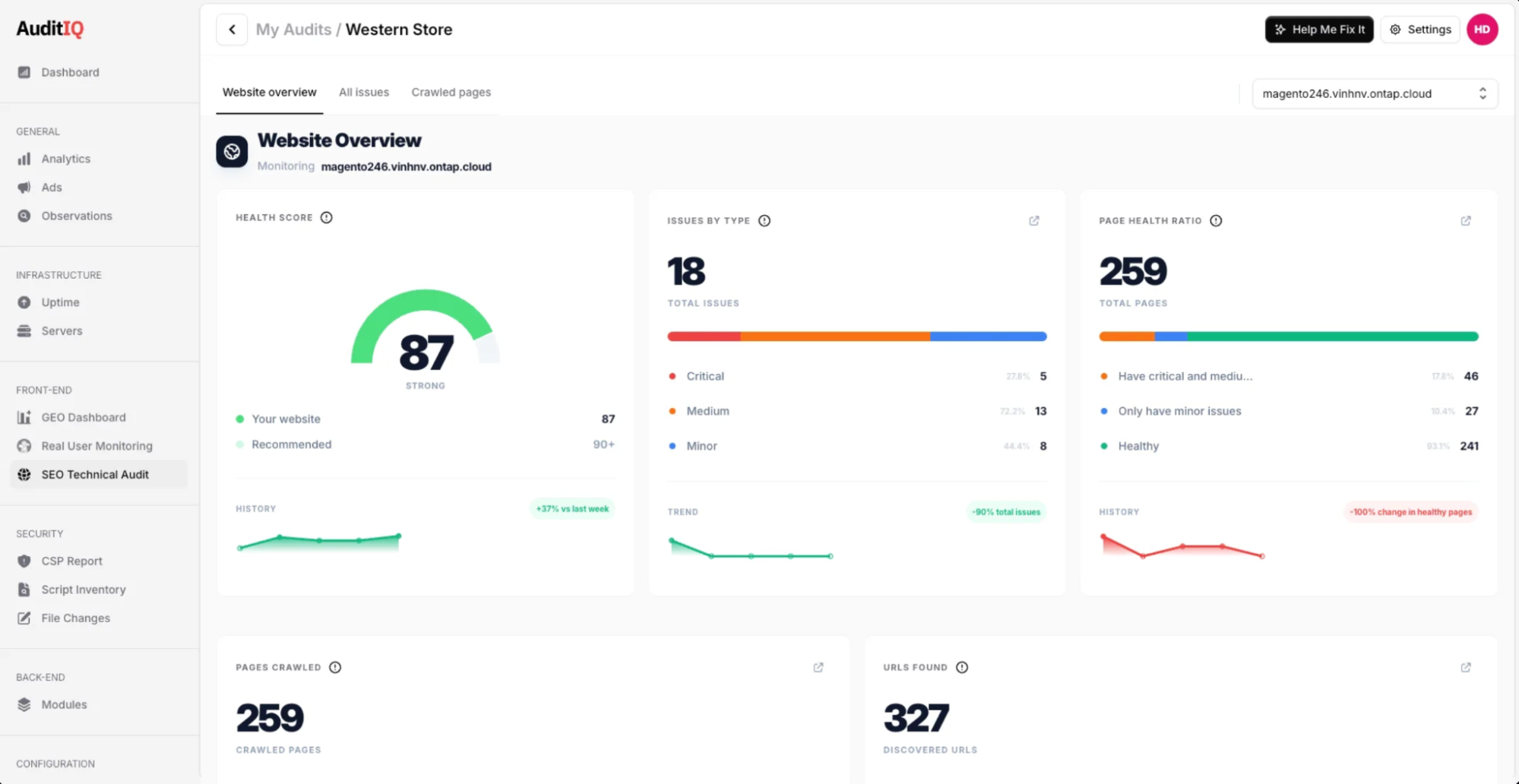
AuditIQ SEO audit crawls up to 20,000 pages weekly, applying 100+ checks per page across titles, descriptions, headings, structured data, internal links, canonicals, speed, and more. Every issue is categorised by severity (Critical, Medium, Minor), linked to industry best practices, and mapped directly to the affected pages so your team knows exactly where to focus. Competitor analysis lets you benchmark your SEO health against up to four competing stores.
2. GEO audit: built for AI visibility
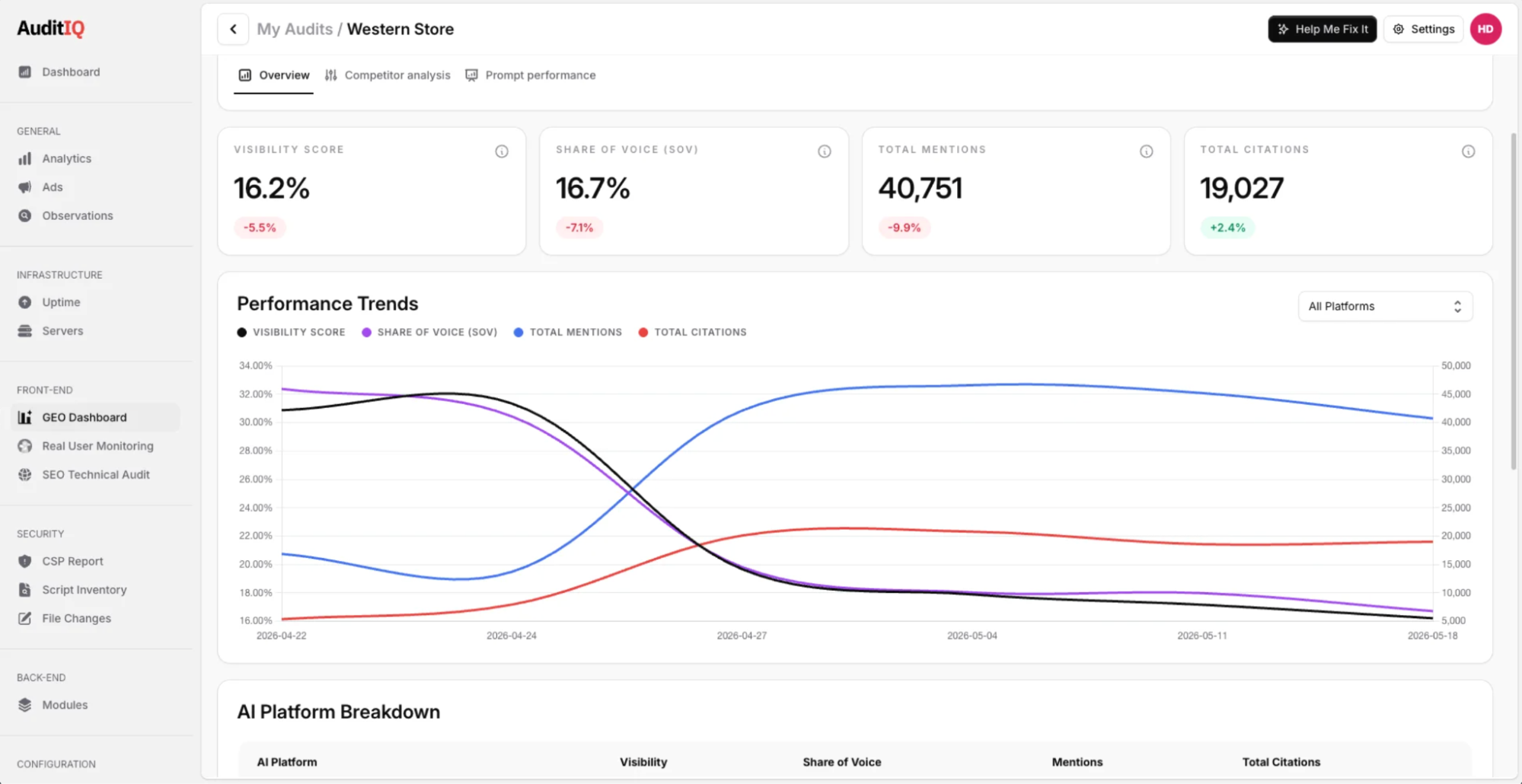
AuditIQ GEO audit analyses your store against a growing set of signals that determine whether AI systems can understand, trust, and cite you:
- Structured data audit. Validates Product, Organisation, BreadcrumbList, and FAQ schema markup for AI readability.
- Entity and brand clarity. Assesses how clearly your brand, products, and categories are defined for AI understanding.
- FAQ and Q&A coverage. Identifies opportunities to add content that directly answers the questions buyers are asking AI assistants.
- AI-citation readiness score. Rates how likely your content is to be cited or referenced by AI search tools, with specific gaps flagged for action.
- Competitor GEO benchmarking. Compares your GEO signals against competitor stores in your category so you can see where the gap is and what closing it requires.
Like SEO, GEO is not a one-off. AI models update, your content changes, and the signals that matter shift over time. Running both continuously means catching a regression before it costs you a quarter of your visibility, not after.
Don’t wait to notice you’ve disappeared
The risk with any discovery shift is the same: by the time the revenue data tells you something has changed, you are already months behind. A structured data regression, a gap in FAQ coverage, a competitor pulling ahead on GEO signals: none of these announces themselves. They just quietly reduce how often your store appears in the answers customers are reading.
Continuous SEO and GEO auditing is how you stay ahead of that.
For merchants, this is visibility protection. Knowing your SEO health and GEO readiness at any point, across your full catalogue, means you catch the regression that matters before it costs you a quarter of organic and AI-referred traffic. The stores winning AI-driven discovery right now are not the ones who optimised once. They are the ones monitoring continuously.
For agencies, this is a client conversation worth having today. Most stores have GEO gaps they do not know about, and most have not been told yet. Walking into a review with a structured data audit, an AI-citation readiness score, and a competitor benchmarking report is both a service and a differentiation. It turns a technical requirement into a tangible demonstration of forward-thinking strategy.
SEO built your organic presence. GEO determines whether AI recommends you. AuditIQ v2 audits both, continuously, in one platform.
Try AuditIQ for free today. Run a GEO audit and get your AI-citation readiness score.
About the author
Dan Garner writes from AuditIQ's experience monitoring eCommerce performance, SEO, security, and reliability issues across Magento, Shopify, WooCommerce, and Adobe Commerce stores.