Isn’t AuditIQ just another monitoring tool? The case for connected observability
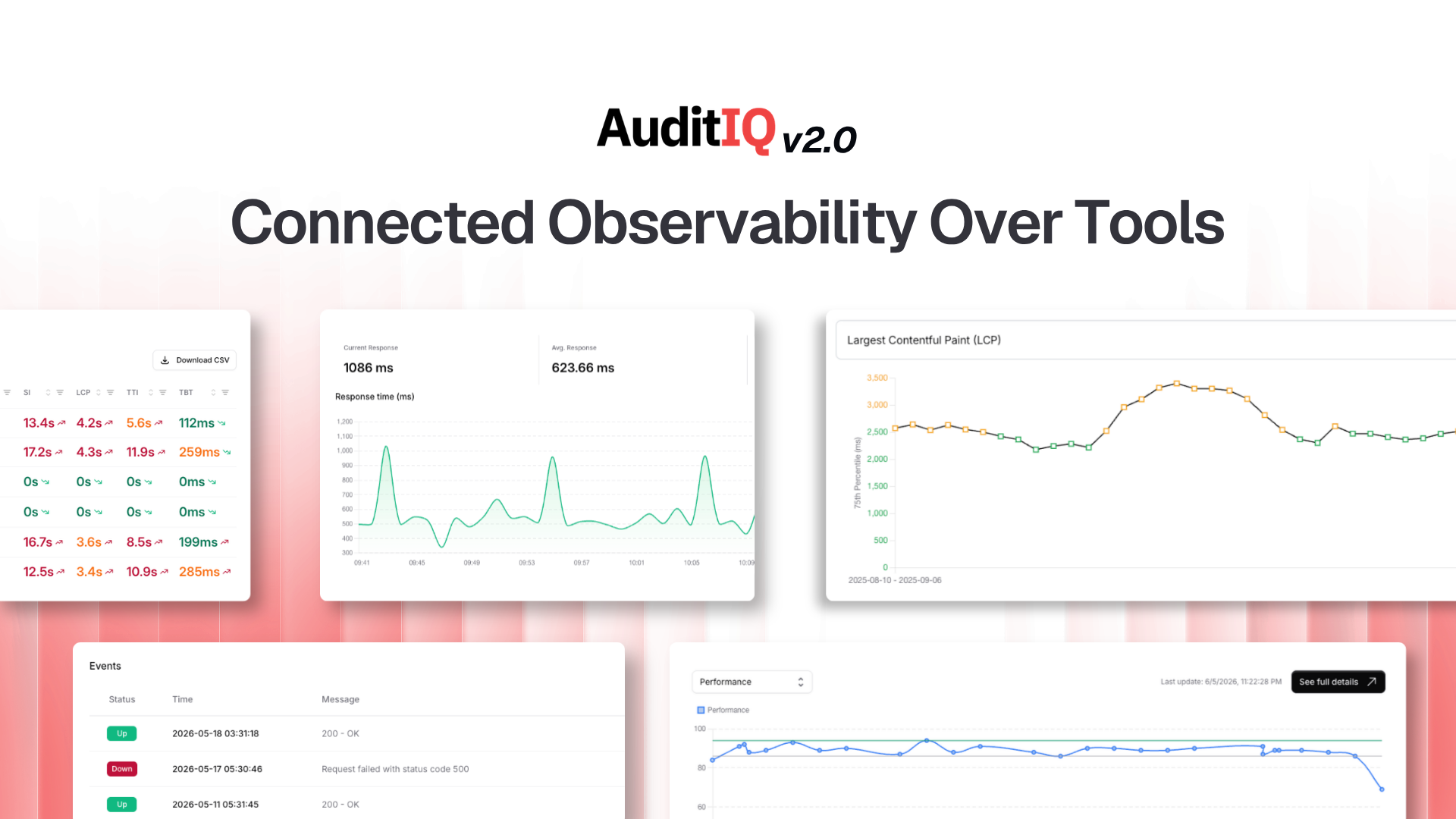
The eCommerce monitoring market is crowded, and most tools in it solve the same narrow problem: watch one thing, alert when it breaks. So when people hear about AuditIQ, the first question is usually "Isn't it just another monitoring tool?"
It is a fair question. Here is the honest answer.
AuditIQ replaces your tools
Most stores don’t run a monitoring tool. They run six. An uptime checker, a performance tool, a security scanner, an SEO crawler, analytics, and ad reporting, each with its own subscription, login and blind spot.
That setup costs more than most teams realise, in three ways:
- Money. Six subscriptions add up fast, and most stores are paying for overlapping features across tools that were never designed to work together.
- Time. Context-switching between six dashboards and running manual checks that stop scaling the moment you manage more than a handful of sites.
- Visibility. Blind spots sit in the seams between tools, in the space where one tool's remit ends and another's begins, and where no single tool is watching.
AuditIQ v2 replaces all six with one platform covering everything your store needs to be monitored. One login, one bill, one place to look, at a fraction of the combined cost of running six separate tools.
On its own, that consolidation is already worth the switch. But it is not yet the real story.
AuditIQ connects what no single tool can
Here is a failure that quietly costs money, and that single-purpose tools are not built to catch:
- A third-party script changes after last night's deploy.
- The script slows down your product pages.
- A security scanner flags the same script as a new, unreviewed addition to your site.
- An SEO crawler notices your page speed score has dropped, unrelated to anything it tracks.
- Conversion quietly drops three days later, and your analytics platform has no idea why.
That single chain spans four different tools: performance, security, SEO, and analytics, each watching its own corner. Everyone of them sees a small, unexplained blip. None of them sees the chain, because none of them was built to look beyond its own slice.
Point tools see slices. The damage happens between the slices.
Because AuditIQ holds every signal in one place, it can overlay them: a security event next to a performance dip next to an SEO change next to a traffic drop, on a single connected timeline. Cause and effect stop being guesswork. That is what a connected observability platform means, and it’s the one thing a standalone tool can never do, however good it is at its slice.
The intelligence layer then ranks what it finds by revenue impact, so you act on the chain that matters.
Why connected observability is so important?
On a live site, a slow page is an annoyance. Someone waits an extra second, maybe leaves, no money changes hands either way.
For merchants, that same second has a price:
- Every 100ms added to page load time can reduce conversion rates by up to 7%.
- As many as 15% of cart abandonments are linked to website errors and crashes.
What makes this worse is how invisible the cause usually is while it is happening. Nothing announces itself. Revenue just quietly drops, a little more each day, until someone finally asks why this month looks softer than last. By the time most teams notice, the damage has already compounded into a real loss, not a minor blip.
Connected observability is how you catch that drop while it is still small, not after it has become a quarter's worth of lost revenue.
For agencies, the stakes are different but just as real
Every agency has had the conversation where a client asks why nobody caught an issue sooner. The honest answer is often "we did not have visibility into that part of the stack".
There is a real difference between the two answers:
- "Your site had an issue."
- "Here is exactly what caused it, when it started, and what we did about it."
The first sounds like an excuse. The second is the reason clients renew. And because every client lives in one multi-client dashboard, your team can trace that same chain across the whole portfolio, without opening a single extra tab or waiting for a client to notice first.
See connected observability on your own store. Book a v2 walkthrough and find out what is quietly costing you revenue right now.
About the author
Dan Garner writes from AuditIQ's experience monitoring eCommerce performance, SEO, security, and reliability issues across Magento, Shopify, WooCommerce, and Adobe Commerce stores.