AI changes how customers find you: Site experience becomes the only moat

Practical Ecommerce published a thought-provoking piece this week: "AI Shifts Product Discovery, not Loyalty." The thesis is straightforward: agentic commerce and AI-powered shopping assistants are fundamentally changing where shoppers begin their purchase journey, but they're not changing why customers choose one merchant over another.
It's an insight that deserves deeper exploration, because the implications for eCommerce operations teams are more urgent than the headline suggests.
The discovery layer is being abstracted away
For years, the eCommerce growth strategy has been centred on owning the discovery layer: SEO, paid search, social advertising, and marketplace placement. The assumption was that if you could get a shopper to your product page, you'd won the hardest part of the battle.
AI agents are disrupting that assumption. When a shopper asks an AI assistant to "find me a waterproof hiking jacket under £150 with good reviews," the assistant doesn't browse Google results the way a human does. It queries multiple sources, compares options algorithmically, and may present the shopper with a shortlist that bypasses traditional search entirely.
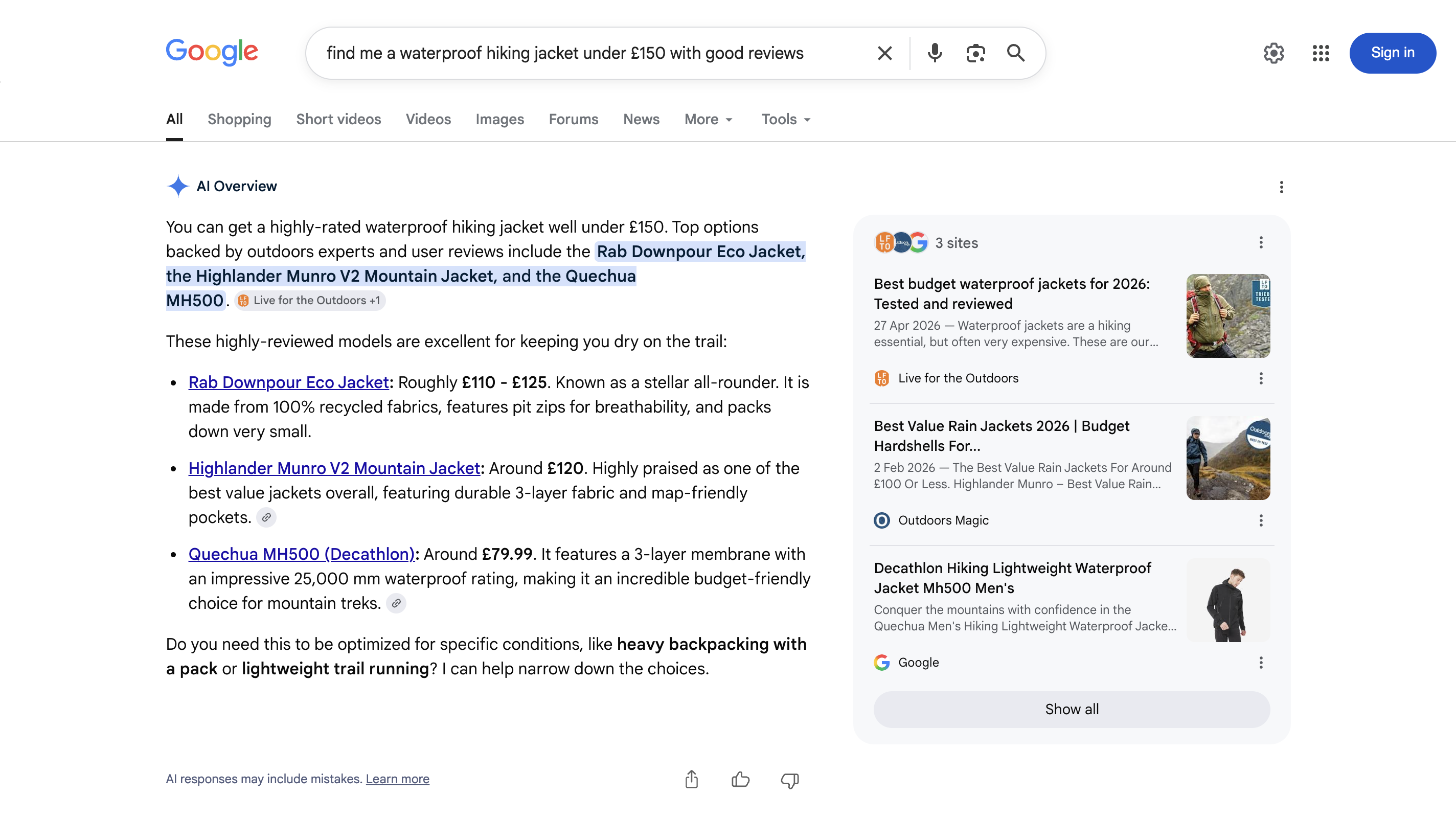
Google AI Overview example
This means the discovery advantage that many merchants spent years building, their domain authority, their paid search expertise, their social retargeting funnels, becomes less of a differentiator. AI agents don't care about your Google ranking. They care about structured data, availability, price, and reviews.
If discovery is commoditised. What's left?
When AI levels the playing field on discovery, the merchant experience itself becomes the deciding factor. And that’s where the real challenge begins, because the friction that costs you the most is also the hardest to see.
This is where the Practical eCommerce article gets it right: loyalty doesn't shift with discovery. A shopper who arrives via an AI agent still evaluates the merchant experience. Can I check out easily? Is the site fast? Does it work on my phone? Do I trust this brand?
And this is where the data becomes sobering. Smashing Magazine's recent exploration of customer understanding, "Four Levels of Customer Understanding", makes a compelling case that what users say and what they do are often very different things. Shoppers won't tell you in a survey that they abandoned a cart because of a 3-second layout shift during checkout. They'll say "I decided to look elsewhere" or "I wasn't ready to buy." The real reason, a technical friction that eroded trust, stays hidden unless you're measuring actual behaviour.
The numbers back this up:
- 14–17% of checkout abandonments are attributable to technical performance issues (Baymard Institute, 2026)
- Every 100ms of page load improvement can boost conversion rates by up to 7% (Amaika, 2026)
- Pages that load in 0–2 seconds see the highest eCommerce conversion rates; the drop-off after that threshold is steep and measurable
In a world where AI agents bring shoppers to your door based on price and product fit, the on-site experience becomes the only variable you fully control. And if your site is slow, buggy, or broken on certain devices, you'll lose those AI-referred visitors to a competitor whose site just works.
The hidden culprits: Why technical friction is so hard to catch
Technical friction rarely announces itself. It hides in the gap between what your site does in a test environment and what it actually does for a real shopper on a mid-range Android phone over a 4G connection. One of the most under-discussed sources of that friction is CSS instability.
CSS-Tricks published "The State of CSS Centering in 2026" this week, cataloguing over 100 different ways to centre an element in CSS, with roughly 60 of them marked as "hacky and not recommended."
Why does this matter for eCommerce? Because layout consistency is directly tied to Cumulative Layout Shift (CLS), one of Google's Core Web Vitals. When developers use fragile CSS patterns, the kind that work in their testing browser but break subtly on others, the result is layout instability that:
- Triggers CLS penalties in search rankings
- Creates visual jarring that erodes shopper trust during checkout
- Causes tap-target issues on mobile where buttons shift beneath a user's finger
The proliferation of CSS techniques isn't just a developer education issue. It's a business issue. Every layout shift during a checkout flow is a micro-moment where a shopper subconsciously questions whether this site is trustworthy.
Monitoring becomes the competitive advantage
The gap between what you think your site does and what it actually does for real visitors is where revenue lives or dies. Closing that gap requires moving beyond synthetic benchmarks and lab tests, and investing in real-user monitoring that reflects the actual conditions your shoppers face.
This isn't hypothetical. The real user monitoring (RUM) market was valued at $3.8 billion in 2025 and is projected to reach $9.2 billion by 2034, growing at 10.3% CAGR. eCommerce teams are investing in production monitoring because they've learned that lab tests and synthetic benchmarks don't capture what real shoppers experience.
When discovery is handled by AI agents and loyalty is earned by on-site experience, the merchants who win will be the ones who know, in real time, exactly how their site performs for every real visitor.
What this means for your team
If you’re running an eCommerce site in 2026, here’s the practical takeaway, and it all flows from the same logic: you may not control how AI agents surface your products, but you do control what happens when shoppers arrive.
- Your SEO investment is still valuable, but it's no longer sufficient. AI-driven discovery means your site needs to compete on experience, not just visibility.
- Your Core Web Vitals are a business metric, not just a technical checkbox. Every millisecond of LCP, every unexpected layout shift, and every sluggish interaction directly impact whether AI-referred visitors convert or bounce.
- Your error monitoring needs to be continuous and revenue-aware. Knowing that a JavaScript error occurred isn't enough. You need to know how many sessions it affected, what revenue was at risk, and which customer segments were impacted.
This is precisely what AuditIQ provides: continuous, real-user monitoring that connects site performance and errors directly to eCommerce outcomes. When an AI agent sends a shopper to your store, AuditIQ ensures they find a site that works, fast, error-free, and trustworthy.
In a world where AI changes how customers find you, your site experience is the only moat that matters. Learn how AuditIQ helps you defend it.
About the author
Dan Garner writes from AuditIQ's experience monitoring eCommerce performance, SEO, security, and reliability issues across Magento, Shopify, WooCommerce, and Adobe Commerce stores.